
Dealers have stocked up vehicles in the run-up to a price hike, which is expected to be announced by leading players some time this month.

Auto major Mahindra & Mahindra on Friday said it will hike the prices of its passenger cars and commercial vehicles by Rs 6,000 to Rs 20,000 from October 1, partly to offset higher input costs and depreciation of rupee against the dollar.

Other players who have declared no production days in the recent past, and during this month, include Mahindra & Mahindra, Maruti Suzuki, Hero MotoCorp, Bosch, Jamna Auto, Wabco and Sundaram-Clayton.

'Some of the launches may get deferred due to the semiconductor shortage, which is unlikely to get resolved before the second half of 2022.'

Just stand in front of his latest film Kochadaiiyaan's hoarding, send an SMS, and watch what happens next.

Hyundai Motor India Ltd (HMIL) on Thursday said it will hike prices by up to Rs 20,000 across models, except the newly launched compact car Grand i10, from October 1 to offset the impact of rupee depreciation and rising input costs.

Various factors, including robust demand in rural markets and good response to new models, helped in driving the sales.

Major automakers, including Maruti Suzuki, Hyundai, Tata Motors, Mahindra & Mahindra, Kia, Toyota and Honda, on Thursday reported healthy growth in passenger vehicles sales in June, recovering from the disruptions induced by the second wave of COVID-19. The country's largest carmaker Maruti Suzuki India (MSI) posted total sales of 1,47,368 units in June, up from 46,555 units in May. Its domestic dispatches to dealers last month stood at 130,348 units, up from 35,293 units in May, as easing of COVID-related restrictions helped the auto major to dispatch more units to dealerships.

Maruti Suzuki, Hyundai and Mahindra failed to register significant growth.

The auto industry has had a mixed month. The build up to Dhanteras and Diwali was good but the demand tapered off subsequently.

Maruti, Hyundai, Tata Motors, Mahindra & Mahindra and Honda saw their passenger vehicle sales improve in August compared to the same month last year, although Ford and Toyota witnessed a decline.

Cumulative sale at India's top six passenger vehicle (PV) makers dropped 0.7 per cent to 267,000 units, from 269,000 a year before.

Japanese auto major Toyota Motor Corp will invest $ 350 million (about Rs 1,400 crore) for setting up a second plant in India as part of its plans to introduce a strategic small car in the country by 2010. The new plant will have a production capacity of 1 lakh units and will become operational by 2010. The new small car, which will have high localisation level, is primarily aimed at the Indian market. Toyota will also be investing further in the plant on support facilities.

Maruti's sales of the compact segment comprising Swift, Estilo, Ritz, Dzire and Baleno went up by 9.9% to 45,579 units

Market leaders Maruti Suzuki and Hyundai, who together control two-thirds of the domestic market, have not yet firmed up a decision on raising prices.

The country's largest carmaker Maruti Suzuki India (MSI) on Monday reported a 11.8 per cent increase in wholesales to 164,469 units in February. The company had sold 147,110 units in February last year, Maruti Suzuki India (MSI) said in a statement. Domestic sales increased 11.8 per cent to 1,52,983 units last month, as against 1,36,849 units in February 2020, it added.

Cumulative sales of India's top passenger vehicle makers -- Maruti Suzuki, Mahindra and Mahindra, Tata Motors, Honda Cars, and Toyota Kirloskar -- increased to 206,418 units in February over 200,322 units in the same month last year, an increase of 3 per cent.

Maruti's exports in May were down 2.4% at 9,089 units

The entire range of Hyundai's diesel cars - from compact ones to SUV models, including the soon-to-be-launched Aura - will be eco-friendly.

The ban does not speak about used luxury cars.

Passenger and commercial vehicle prices are expected to rise as automobile companies invest in upgrading vehicles to meet stricter emission norms that kick in from April next year. The Indian automobile industry is currently working to make their products meet the second phase of Bharat Stage VI, equivalent to Euro-VI emission norms, in real time driving conditions. Four-wheeler passenger and commercial vehicles will need more sophisticated equipment to be added to meet the next level of emission standards.

Maruti Suzuki, Hyundai, Mahindra and Toyota reported low single-digit sales growth for the month owing to weak market sentiment
In a rare face off, captains of the auto industry have hit out at the government for not walking the talk. At an industry event in the capital on Wednesday, R C Bhargava, chairman of India's largest carmaker Maruti Suzuki, and Venu Srinivasan, chairman of TVS Motor, questioned the government's intent to support the auto sector. Revenue secretary Tarun Bajaj sat in the audience listening, before his turn came to counter them.

Apart from a pavilion of vintage cars, there will be a Bollywood corner

The GST Council last year imposed a cess of 15 per cent on hybrid vehicles, in addition to the 28 per cent GST, leading to a total tax burden of 43 per cent against a previous tax rate of 28 per cent.

Maruti has announced it will phase out diesel variants from April 1, 2020, when stringent BS VI norms take effect

The industry needs stimuli to help revive consumer demand and conversions.

The government has mandated that from October 2017, all new car models will have to be equipped with airbags to meet crash test norms.

While home-grown firms like Tata and Mahindra have been actively participating in the government's e-mobility mission, by launching electrified versions of their existing models, the global firms believe electric is not the best solution for a country where the primary source of power generation is coal, and where infrastructure is a big impediment.
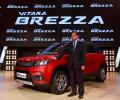
Maruti Suzuki and Hyundai would make the largest gain.

Cars and two-wheelers attract 28% GST and a cess in the range of 3-22%, taking the effective tax rate to up to 50%.

'The promises of netas and babus and new laws, however well-meaning, mean little.' 'What matters is implementation on the ground.' 'Every law is finally implemented by a vast army of offici

Since existing laws do not cover Covid-19, any compensation in this regard has to be left to the discretion of companies.

A weaker rupee against the US dollar and the Japanese yen along with margin sustenance pressures have forced companies to raise prices.

Passenger vehicle majors like Hyundai, Tata Motors, M&M, Toyota Kirloskar and Honda on Wednesday reported growth in domestic sales in August riding on festive sentiments, although market leader Maruti Suzuki posted a decline amid a semiconductor shortage affecting the industry. The country's largest carmaker Maruti Suzuki India Ltd (MSIL) reported domestic sales at 110,080 units, as compared to 116,704 units in the same month last year, down 6 per cent. "Sales volume of the company in August 2021 was affected due to electronic components shortage.
While hybrids, CNG and biofuels found favour in 2018 among many carmakers including Maruti Suzuki, Mercedes-Benz, Toyota and Honda, others such as M&M and Tata Motors have shown full faith in electric vehicles.

During September, Maruti said it dispatched 1,375 units of the soon-to-be-launched sedan Ciaz.

High-end mid-sized sedans, comfy SUVs and entry-level luxury models steal their show.

A clutch of automakers including Maruti Suzuki, Hero MotoCorp, Mercedes Benz India, Eicher Motors, TVS Motor, and Isuzu Motors India announced they had got the clearance from the governments of the states they operate in to resume operations.
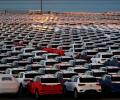
Reflecting the mood, passenger vehicle sales in November either remained muted or skidded for most manufacturers as high fuel prices and the higher cost of borrowing dampened buying sentiment.
 © 2026 Rediff.com - Investor Information - Advertise with us - Disclaimer - Privacy Policy - Sitemap - Feedback - About us - Terms of use - Grievances